
Share this
June 15, 2026
BIALL 2026 did not disappoint! The conversations were sharp, the energy was good, and it was great to spend time with such interesting professionals in the industry. We came away with plenty to think about!
One of the highlights for our team was the session we ran together with two brilliant panellists: Jas Breslin, Research and Information Services Senior Manager at Charles Russell Speechlys, and David Shaffer, Research Specialist at Ashurst. The panel was titled “Optimising Subscriptions: Transforming Resources into Measurable Value,” it was a fully-booked talk and generated a lot of great discussion before and after!
Here is a summary of what we covered, and what we think is most worth taking back to your own teams.
The pressure every knowledge team is feeling
We opened the session by naming what everyone in the room already knew: budgets are flat or shrinking, but the content landscape keeps expanding. New challenges (or opportunities depending on your view) are arriving every month, from software to AI tools. The case for every subscription has to be made more rigorously than ever, and the days of “we’ve always had this” are over. Firms want evidence, and knowledge teams need the tools and the data to provide it.
The question we put to Jas and David was simple: how do you move from a vague sense that a resource is being used, to being able to demonstrate it? Both of them had done exactly that through very different projects.
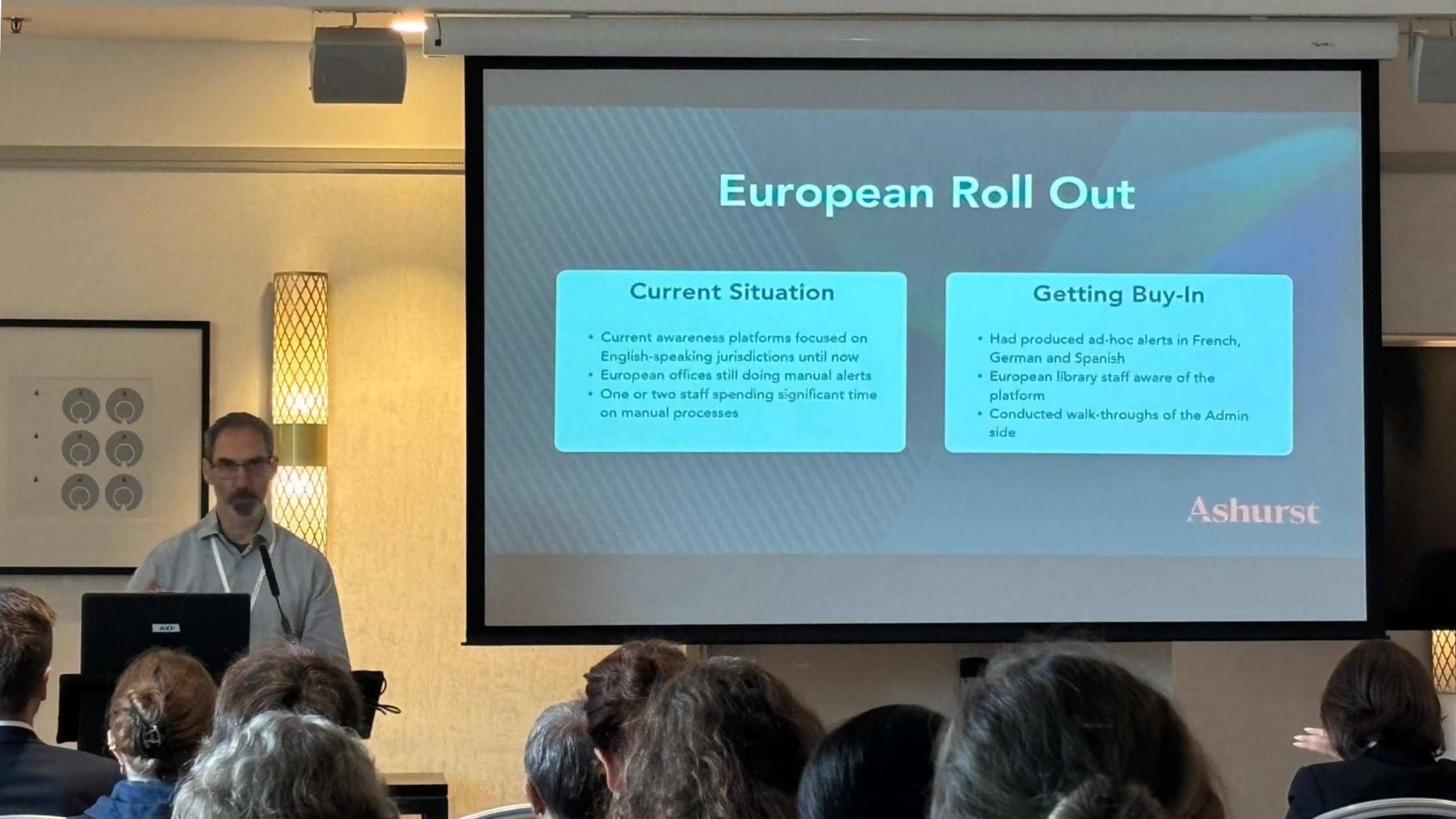
David’s story: rolling out current awareness across Europe
David walked us through Ashurst’s project to bring their European offices onto the same current awareness infrastructure already working well in London and Sydney. The UK and Australian teams had been running automated alerts for years. The European offices, mostly smaller teams or solo researchers, were still manually monitoring regulators and pasting links into emails. Most mornings, that was eating up several hours.
What finally moved the needle, David said, was treating it as a real project with defined outcomes, and then running hands-on walkthrough sessions for the European teams. Until people could actually see inside the platform and understand how it worked, it felt like something being imposed on them from head office, rather than a beneficial update. Once they could see how to build a topic, run a Boolean search, and set up alerts, they could explain it to the lawyers in their own offices. That shift gave them ownership, and that made all the difference.
The results were significant: a 66% increase in requests from European colleagues after the project completed, and much stronger relationships with BD teams in Germany and France in particular. David was also refreshingly honest about the challenges. Quality control in languages other than English takes a lot longer than you expect. What takes 20 seconds to assess in English can take five minutes in French or German. That is not a reason not to do it, but it is a reason to build it into your planning and set expectations accordingly.
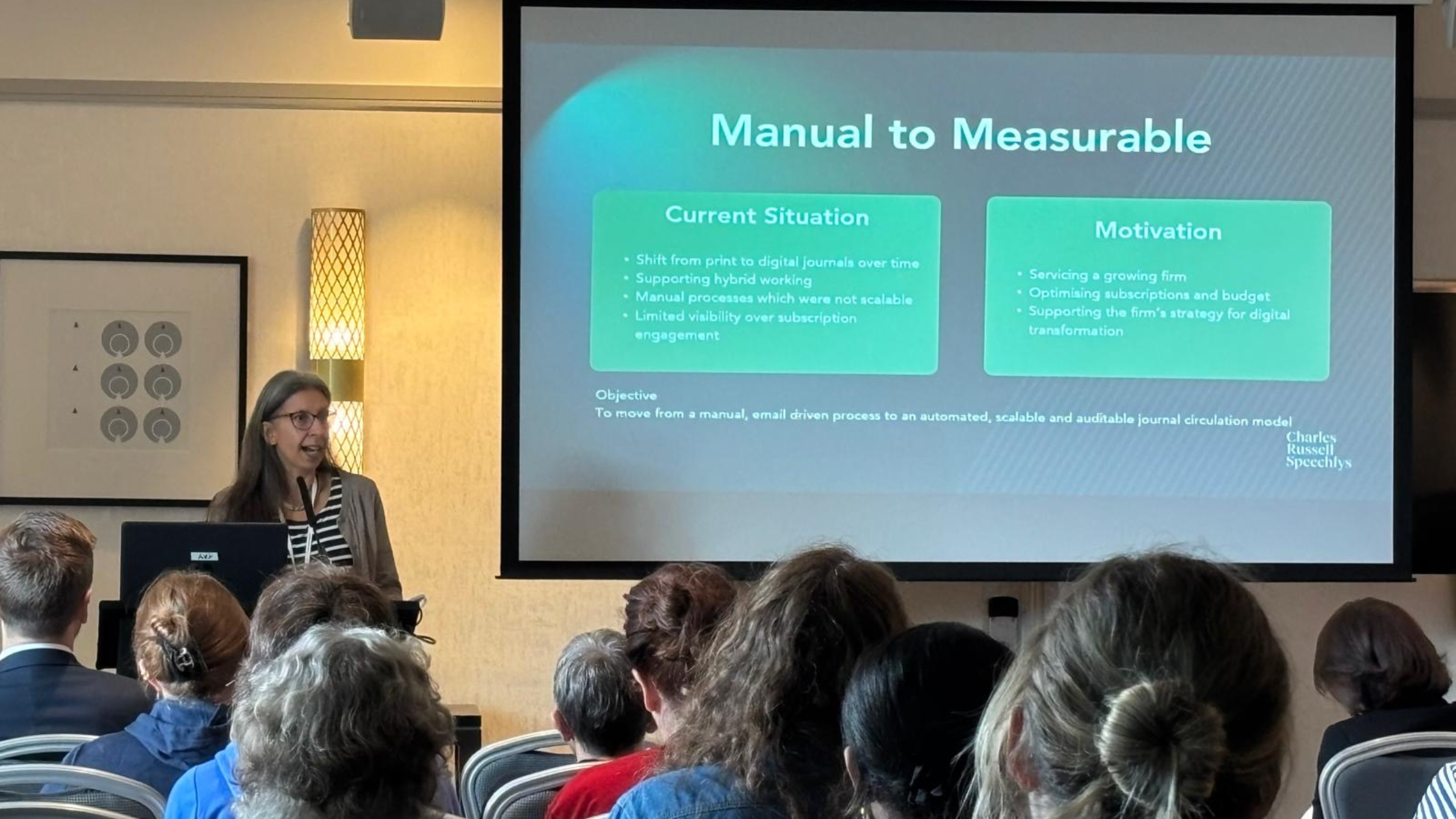
Jas’s story: automating journal circulation at Charles Russell Speechlys
Jas’s project had a different starting point but a very similar destination. During the COVID pandemic, her team had moved to manually distributing digital journals by email, downloading PDFs and forwarding them to Outlook distribution lists. It was a pragmatic fix that became a permanent fixture, and by the time the firm was back to normal, it had grown into something genuinely hard to sustain: admin-heavy, difficult to scale, vulnerable to staff absences, and almost impossible to measure.
The team now has 74 legal journals and updates circulating automatically through Vable. Users can control what they receive and how often. Onboarding new joiners is faster. And the data that comes back is genuinely useful: click-through rates, subscriber numbers by title, engagement patterns that tell you which content is landing and which is not. That is a completely different conversation to have at renewal time compared to “we think people are reading it.”
Jas made a point that stuck with a lot of people in the room: the freed-up capacity matters as much as the efficiency gain. When researchers are not spending their mornings on manual distribution, they can focus on the work that actually requires a trained information professional. That is good for the team, and it makes a stronger case for the team’s value to the business.
What both projects had in common
Looking across both stories, a few things stood out. Both started with a clear, specific problem rather than a desire to adopt a new technology. Both involved genuine investment in training and communication, so users understood what was changing and why. Both produced usage data that made the conversation about subscriptions evidence-based rather than anecdotal. And both delivered measurable time savings alongside better utilization of resources the firms were already paying for.
There was real energy in the room during the Q&A, and plenty of people stayed afterward to continue the conversation. If you missed the session and would like to talk through how any of this might apply to your own team, we would love to hear from you.
Thank you to Jas and David for sharing their work so openly, and to everyone at BIALL who made the week such a good one.
Thinking about how to get more from your subscriptions? We'd love to talk Book a 15-minute call with our team
Further reading: Optimizing the tech stack - what to keep, replace, or consolidate