
Share this
December 16, 2025
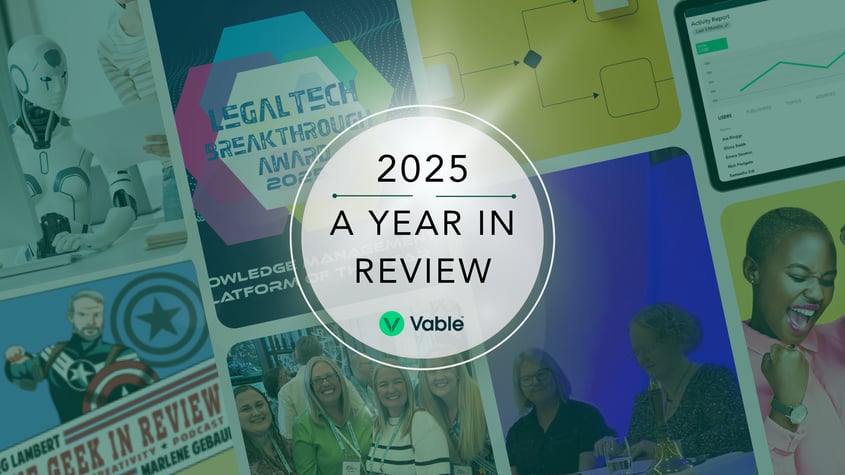
What a year 2025 has been.
While the legal industry has been arguably slow to pick up the ‘tech’ baton, it’s definitely making up for lost time. So much is changing so quickly in legal tech, but it’s an exciting time to be in knowledge or information teams and right in the middle of the action.
In 2025, the Vable blog explored how legal information professionals are evolving their practices in the face of tech change, shifting expectations, and organizational pressure. It’s a lot to consider, from horizon scanning and future proofing to AI and how to implement it effectively. We’ve also discussed migration and workflow transformation, and how measurement can help with value and business outcomes.
So let’s explore:
Horizon Scanning and Future Proofing
While most content aggregation focuses on current awareness, there is a growing trend to use platforms like Vable for horizon scanning and landscape analysis.
Horizon scanning is a structured method for identifying emerging trends, early signals, risks, and opportunities that may affect an organization in the future. We explored this in detail in a talk alongside Julie Ferris and Diane Stitt, Research Analysts at A&O Shearman, at BIALL 2025. You can read it in more detail in our article Not Just News: The Surprising Power of Horizon Scanning.
Horizon scanning goes beyond traditional current-awareness alerts by focusing on emerging long-term trends - be they legal or regulatory, market and industry, or regional macro-shifts - rather than just what’s happening now.
It’s a useful strategic tool for organizations because it allows them to identify early signals of change, helping them mitigate risks before they escalate and seize emerging opportunities ahead of competitors. It strengthens decision-making by providing a broader context about external trends, and it also enhances the role of information professionals by shifting their contribution from reactive support to proactive, future-focused insight that adds strategic value.
AI, Automation, and Human Expertise
There’s been a huge amount of hype around AI in 2025, and we covered a lot of that in our article Automation vs AI: What’s the Difference and Why Does it Matter earlier this year.
While automation and artificial intelligence (AI) are often used interchangeably, they serve distinct functions: automation follows predefined rules and workflows to manage repetitive tasks, whereas AI mimics human intelligence, adapts over time, recognizes patterns, and helps with insights. This difference is important because automation is typically simpler, lower risk, and lower cost to implement, while AI carries higher investment, higher complexity, and greater risk - for example, hallucinating or copyright infringement.
The overarching theme of the year is that AI and automation do not, in any way, replace human skills and expertise. That will remain an essential element. Teams will also need to put in clear measures to protect against the risks associated with AI.
The best option for library teams is to use this technology in tandem with their own skill set to get the best outcomes, with increased efficiency.
Managing Migration
Another key theme this year has been migration. And it’s no surprise - the majority of people we talked to at BIALL and AALL this year said that even if they are frustrated with their incumbent current awareness platform, the effort involved in moving years of work from one platform to another would give them pause.
And it can be overwhelming. Many teams have years' worth of searches and taxonomies in their current awareness platform - they don’t want the worry of having to start from scratch, combined with the huge learning curve that accompanies a new piece of software.
Given the frequency of these comments, it’s no surprise that we covered this regularly in 2025 - including with our article How to Plan a Successful Migration from Legacy Systems.
The good news is that migration doesn’t have to be the burden many people expect. With planning and support from your new provider, it can be much easier than you think.
Measuring the Value of Library Teams
A final theme that emerged repeatedly throughout 2025 was the importance of measurement. With budgets under pressure and expectations rising, library and knowledge teams are being asked more often to demonstrate their impact on the wider business. This isn’t about vanity metrics - it’s about clearly showing how information professionals contribute to risk reduction, efficiency, revenue enablement, and strategic decision-making.
In Self-Advocacy: How to Elevate Knowledge Management, we explored practical methods for proving value, from usage analytics and workflow improvements to stakeholder feedback and outcome-based reporting. The takeaway is simple: when teams can quantify their contribution, they gain visibility, influence, and stronger alignment with organizational priorities.
As technology evolves and workflows shift, measurement becomes even more crucial. It ensures library teams remain seen - not just as service providers, but as essential partners in organizational success.
Looking Ahead to 2026
If 2025 was the year of rapid change, 2026 is shaping up to be the year of refinement. Based on everything we’ve seen this year, we anticipate a few clear trends:
-
Deeper, more thoughtful AI integration
Organizations will move beyond experimentation and start embedding AI into core workflows - supported by guardrails, governance, and human oversight. -
Stronger ethical and compliance frameworks
With more AI-generated content and increasing questions around copyright and provenance, businesses will double down on transparency, permissions management, and responsible information use. -
More cross-team collaboration
Library teams will continue shifting from isolated departments to central hubs of knowledge - working closely with IT, innovation teams, legal operations, and risk teams to drive smarter, more efficient processes. -
Greater focus on workflow transformation
Teams will rethink legacy systems, eliminate manual tasks, and use automation strategically to free up time for higher-value, expert-driven work.
If 2025 taught us anything, it’s that the legal and information landscape isn’t slowing down. But with the right mix of technology, governance, and human expertise, organizations are more prepared than ever to manage knowledge at scale.
Stay Connected
If you’d like to stay ahead of these trends, make sure you’re subscribed to the Vable blog for fresh insights, practical guidance, and real examples from information teams around the world.
And if you’re exploring new current awareness or workflow automation solutions, we’d love to show you what Vable can do - get in touch for a demo or free trial and see how we can support your goals in 2026 and beyond.